
Make the flat usable
Cleaning supplies, bin bags, toilet paper, a towel, basic cookware, drinking water and the right plug or cable.
Build the first-day list →Your first home errands · Tbilisi · 2026
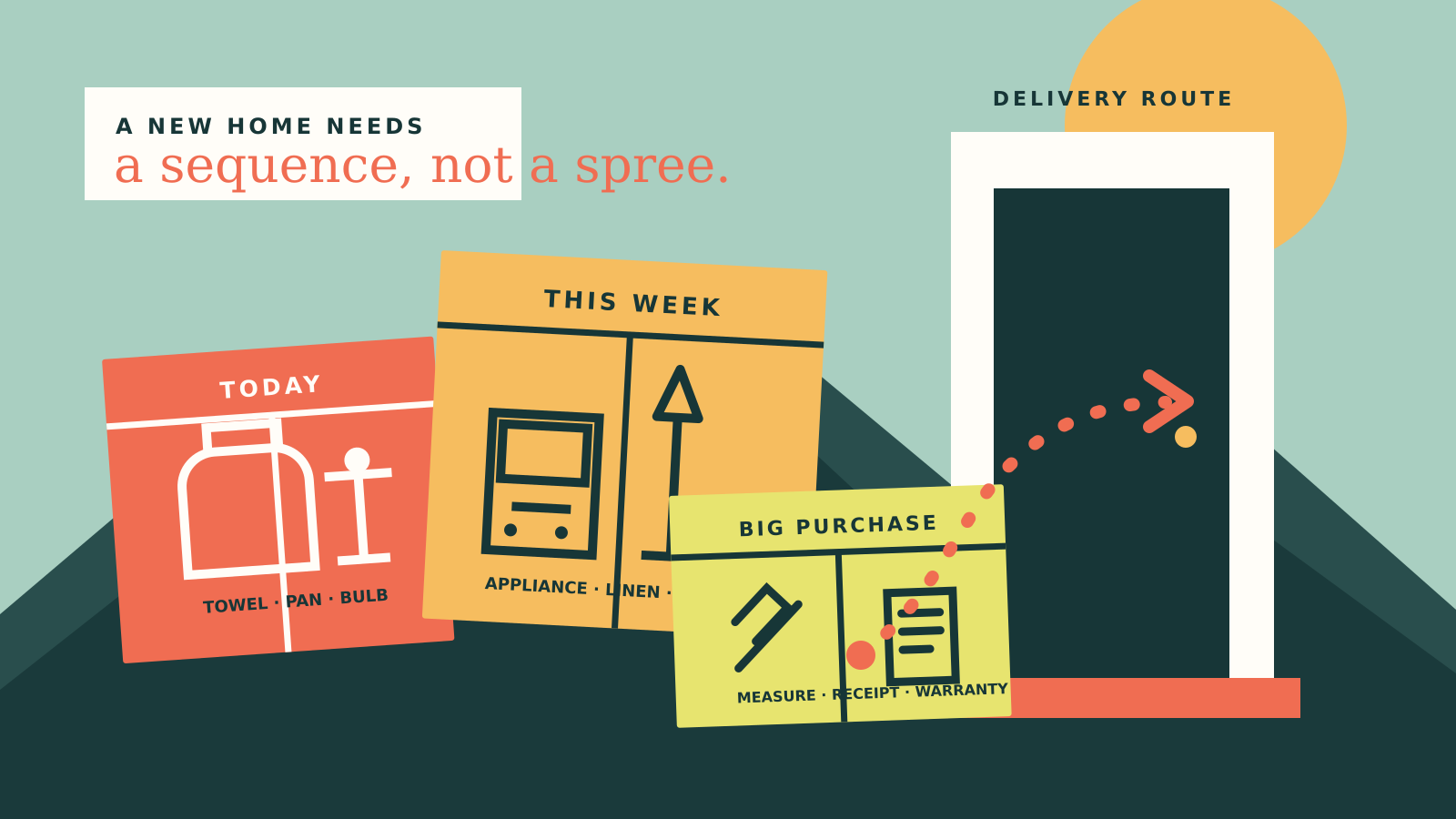
Start with the missing towel and kettle. Slow down for the washing machine. This guide separates urgent basics, specialist shopping and delivery questions so one expensive purchase does not derail your first week.
How this guide works
Retailers are included because their current catalogues or policies answer a practical newcomer question. Inclusion is not an endorsement and “best” or “cheapest” is not claimed. Exact stock, branch facilities, prices, delivery windows and return decisions remain with the operator.
For a large purchase, use the retailer page as a starting point and get the promise for your exact item and address in writing. For physical access, ask the exact branch about the entrance, route, lift and toilet; a mall’s general facilities label is not evidence that every tenant or route is barrier-free.
The task chooser
One neighbourhood errand is often smarter than crossing Tbilisi for a small saving. Combine journeys only when you need comparison, specialist stock or a documented large-purchase process.
Cleaning supplies, bin bags, toilet paper, a towel, basic cookware, drinking water and the right plug or cable.
Build the first-day list →Compare the exact model, voltage, measurements, warranty provider and delivery route—not just the headline discount.
Plan an appliance purchase →Measure the room, doorway, stair turn and lift before you order anything that arrives assembled or boxed.
Choose a homeware route →Take a photo, dimensions and the old part. Product vocabulary and compatibility matter more than browsing a giant aisle.
Prepare the repair errand →A multi-store centre can save transfers when clothing, shoes, pharmacy, electronics and household goods are all on the list.
Compare practical clusters →Ask where the truck stops, who unloads, whether the team carries upstairs and what happens if the item does not fit.
Use the delivery checklist →Save the order, receipt, serial number, warranty terms, courier document and photos of the sealed and opened item.
Understand the records →Map repeated essentials around your neighbourhood, then reserve cross-city trips for uncommon or bulky purchases.
Design a local routine →Shopping for a new Tbilisi home is three different jobs. The first is making tonight comfortable. The second is filling gaps you notice during the first week. The third is buying items expensive or bulky enough that the receipt, warranty, installation and route through the building matter as much as the product.
Before leaving temporary accommodation or meeting a landlord, write the list by room. A basic kitchen list might include one pan, one knife, a board, plates, cups, washing-up liquid and a sponge. Add a towel, bedding if it is not supplied, toilet paper, laundry detergent, bin bags, surface cleaner, bulbs and drinking water. Photograph the sockets and any missing cable or adapter. Check whether the hob is gas, electric or induction before buying cookware.
Start with a supermarket or household shop close to the flat. This is deliberately not a catalogue of chains: nearby stock changes and the right answer depends on where you live. The Markets & Groceries guide explains how supermarkets, neighbourhood shops, produce markets and delivery fit together. For the first evening, distance and opening status usually matter more than saving a few lari on a basket.
Rental boundary: a bulb, shower curtain or kettle may be your choice; drilling walls, replacing fittings or disposing of an appliance may not be. Get the landlord’s written agreement before changing the property or deducting a purchase from rent.
Alta is one current starting point for phones, computers, televisions, large and small appliances, and house-and-garden electrical products. Its English-language site is useful for identifying categories, model numbers and operator policies. It is not a price verdict. Search the same exact model code elsewhere, then compare what is actually included: plug, cable, stand, hose, installation, removal of packaging, delivery and warranty route.
For a refrigerator, washer or oven, record width, depth and height twice: the product and the packaged carton. Measure the building entrance, lift door, lift cabin, stair width, landing turns and apartment door. Alta’s current delivery conditions require a usable driveway or path, working lift and safe stairs; they also say an item that does not fit may, with consent, be handed over outdoors unopened or returned to the warehouse. That is a vivid reminder to settle carry-in conditions before paying.
Keep a photo of the serial number after installation. A retailer receipt, manufacturer warranty and service-centre process are related records, not interchangeable promises. Ask the seller to identify which document controls the exact product.
For towels, sheets, curtains, storage and simple furniture, decide whether the priority is “carry it today” or “deliver a chosen size.” JYSK Georgia is one task-led option for bedding, textiles, storage, mattresses and furniture. Its current delivery page describes a paid nationwide service and a call before delivery, while its online return page describes a 14-day operator policy with conditions and return costs. Those pages were checked on 19 August 2026, but the delivery page itself shows an older update date; confirm the current promise for your cart.
Textiles need their own measurements: mattress width, length and depth; duvet size; curtain drop and rail width. Furniture needs the route as well as the room. Ask whether it arrives flat-packed, assembled or in multiple boxes; whether assembly is offered; where packaging is left; and whether a missed delivery returns to a warehouse. A sofa shown in a photograph can still fail at a tight stair turn.
If you want IKEA specifically, do not rely on casual marketplace descriptions. Use the separate How to Buy IKEA in Georgia guide, which keeps reseller, ordering and delivery questions in one place without duplicating them here.
Gorgia and Domino both cover broad home-improvement jobs: tools, repair materials, plumbing, lighting, household goods, garden products and larger home items. Gorgia’s current catalogue also spans construction, furniture, appliances and textiles. Its homepage displayed a high-demand warning on 19 August 2026 saying order processing and delivery were taking longer and pickup customers should wait for the operator’s call. Treat a standard policy timetable as provisional whenever a live warning says otherwise.
For a small repair, do not begin with an English product name alone. Take a clear photo in place, another beside a ruler, the removed part if safe, dimensions in millimetres and any code stamped on it. Ask a Georgian-speaking friend, landlord or technician to confirm the term when compatibility matters. For plumbing and electrical work, buying a plausible part is not a substitute for a qualified installer.
Delivery scope deserves a separate question. A current Domino product page displays service wording about delivery without unloading or lifting to the door. A product-page banner is not a verified promise for every cart, but it is enough reason to ask: “Does this price include unloading from the vehicle, carrying to my floor and bringing it inside?” Record the answer in the order or message thread.
“Delivery” may mean to the address, to the building, to the vehicle-side handoff or through the apartment door. Make the noun and endpoint explicit.
A mall earns the journey when several unrelated needs can be solved in one stop. Check the current tenant list before leaving; do not assume that a category exists because it was there on a previous visit.
For shoes or clothing, check the retailer’s fitting, exchange and refund policy before removing tags. A brand’s policy may differ by country, store format and whether the order was online or in person. Keep card slips and receipts until you have worn the item indoors long enough to confirm fit without damaging it.
Before paying for a heavy or expensive item, send the seller the address, map pin, floor, lift details, stair conditions and access restrictions. If a courtyard gate, bollard, steep lane, low arch or construction zone separates the truck from the door, say so. Ask who pays if the team arrives and cannot complete the agreed handoff.
Use it for appliances, mattresses, furniture, large DIY orders and anything requiring installation.
For a built-in appliance or furniture installation, distinguish delivery from assembly, and assembly from electrical, gas or plumbing connection. These may involve different providers. Photograph pre-existing floor, wall and doorway conditions before work begins, then photograph the serial plate and completed setup.
A Georgian address can be written correctly and still be hard for a courier to use. Enter the official street and number, then add the building or block, entrance, floor, apartment, intercom and a reliable local number. Save the map pin and a short landmark note. If the site accepts only Georgian script or requests a personal number, understand why the field is required before submitting sensitive data; do not send identity documents through an unofficial chat.
Keep screenshots or a PDF of the product page, final basket, delivery promise and return terms at checkout. Promotions and stock messages can change after purchase. When the operator calls, confirm the product, amount, date, address and endpoint rather than saying only “yes.” If you need English support, test the communication channel before committing to a time-sensitive order.
Never assume “pickup available” means the order is already waiting. Gorgia’s current high-demand notice specifically tells pickup customers to wait for the operator’s call. Other retailers may use a similar confirmation step even when the site shows branch stock.
Georgia’s Law on the Protection of Consumer Rights includes a withdrawal route for many distance and off-premises contracts within 14 calendar days, subject to conditions and exceptions. That is not a blanket promise that every in-store purchase can be returned because you changed your mind. A defective item, an online withdrawal, a voluntary shop exchange and a manufacturer warranty are different situations.
Alta’s current online-return page, for example, describes a 14-day process for individual consumers, with exclusions and conditions including complete accessories and particular packaging or activation requirements; it also says the customer bears return transport costs. JYSK publishes its own online-return conditions. Read the operator page for the exact channel used, save the version visible at purchase and ask before opening or activating an item when that action could affect the process.
If the matter cannot be resolved, the official Georgian Competition and Consumer Agency publishes contact details and a consumer application route. This page provides general information, not legal advice; an individual dispute may need advice on its own facts.
IKEA buying in Georgia has enough reseller and delivery complexity to require its own guide; use our dedicated IKEA page rather than treating any listing as official stock. For second-hand goods, agree on the exact item, condition, collection point and payment method. Test an appliance safely before paying, obtain any available receipt or ownership record, and do not expect retailer-style returns or manufacturer cover from a private sale.
The Dry Bridge flea market is appropriate for browsing art, vintage objects and occasional household finds. It is not a dependable first-day source for a specific mattress size, safe electrical appliance or documented warranty. Use it because the object and experience suit you, not as a universal “cheap essentials” recommendation.
Radius one is walkable: food, pharmacy, cleaning supplies, a small household shop, cash access and parcel or courier handoff. Radius two is one simple transit journey: electronics, DIY, clothing and a centre where several errands can be combined. Record the route home as carefully as the route out. Bags, hills, heat, rain and a transfer can turn a theoretical bargain into an expensive taxi.
Use the Neighbourhoods guide to understand terrain and daily routine, the Transport guide for payment and route planning, and the Cost of Living guide to separate one-off setup costs from a normal monthly budget. If you are planning the whole first month, put large purchases after housing measurements and connectivity decisions in the First-Month Planner.
Before travelling, contact the exact branch and describe the route you need: step-free entrance, ramp gradient, door width, lift dimensions, accessible toilet, seating, quiet time, assistance carrying goods, parking or taxi drop-off. Ask whether the route remains open during construction and whether every floor or tenant is reached by the same lift. A general “accessibility” icon on a centre’s services page is a prompt to ask for details, not a description of the complete journey.
For delivery, describe mobility or communication needs when booking and ask the operator to record them. Confirm whether the driver will call, text or use the intercom; whether someone must meet the vehicle; and whether the team crosses the threshold. When a route is described as step-free or barrier-free, ask for measurements and a description that match the access you need.
Send the seller the product or model, full address, floor, lift and access details. Ask which parts of the price cover delivery, unloading, carrying inside, assembly and installation, and keep the answer with the order.
Save the product page, basket, receipt and return terms visible at checkout. Inspect the item before discarding packaging, record any problem promptly and use the seller’s official return or warranty channel.
Updated 19 August 2026
Official law and regulator pages support the consumer-information section. Retailer pages document their published categories and terms; they are not independent quality ratings.