
Greens and sour fruit
Field greens, tarragon, green garlic, sorrel, jonjoli and fresh green plums reset the flavour of the table.
Open spring →What to eat and buy · Tbilisi 2026
A month-by-month guide to the greens, fruit, harvest dishes and preserved foods that make the market worth revisiting—without pretending the weather follows a publishing schedule.
A calendar, not a train timetable
Georgia’s regions do not ripen together. A warm spring, a late frost, rain, altitude, cold storage and imports can all move the edges of a season. The month headings below are therefore invitations to look, taste and ask—not promises that a particular fruit will be perfect on the first day of the month.
The most useful signal is repetition. When the same ingredient appears across several stalls, in more varieties and at more forgiving prices, the season is speaking. Buy a little on the first appearance; buy for jam, freezing or a long table when abundance is obvious.
The year in four movements
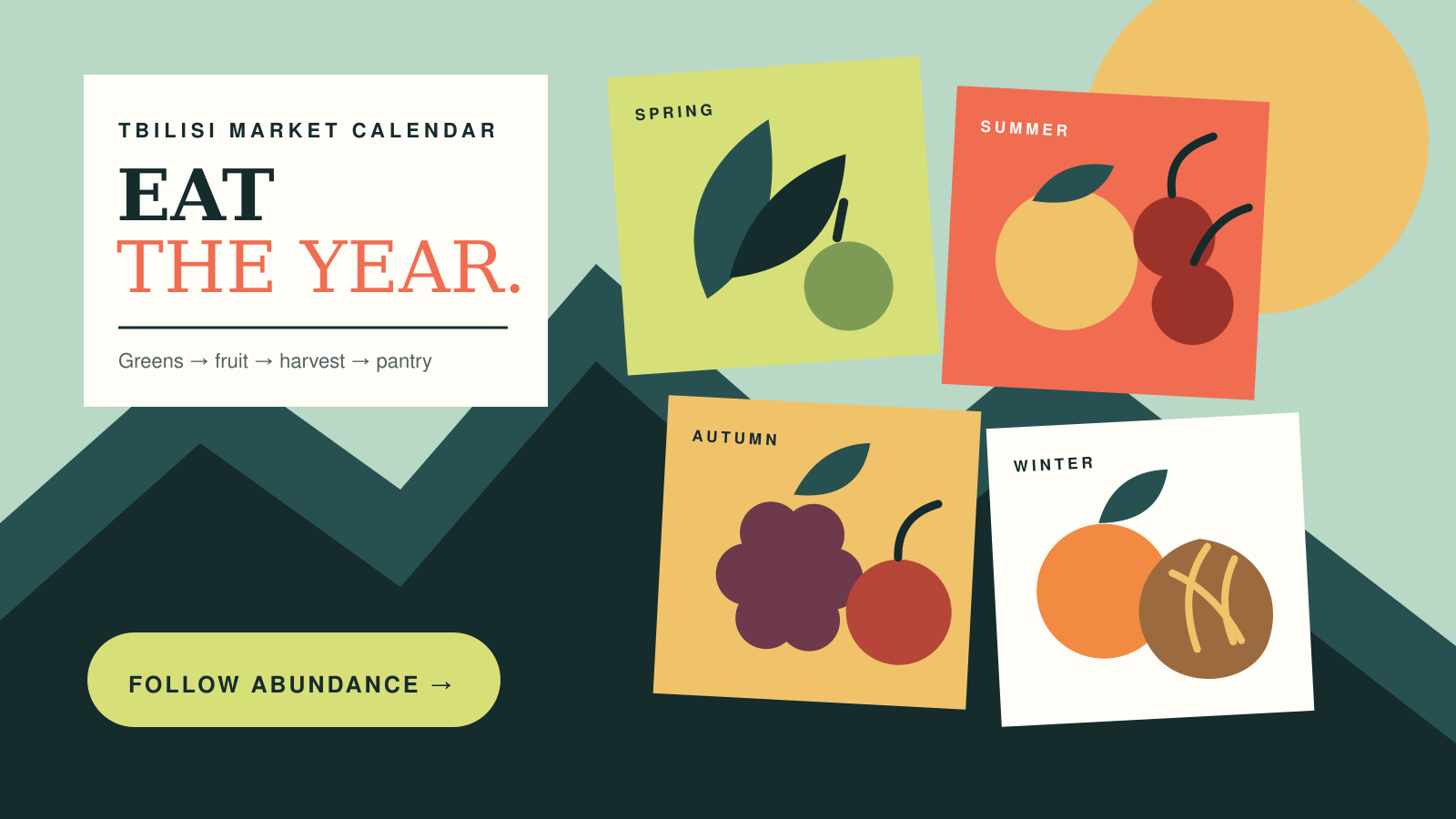
Spring is green and sour. Summer is fruit and the salad table. Autumn is harvest and preservation. Winter belongs to citrus, walnuts, beans, pickles and the work done earlier in the year.
Field greens, tarragon, green garlic, sorrel, jonjoli and fresh green plums reset the flavour of the table.
Open spring →Cherries, berries, apricots, peaches, tomatoes, cucumbers, melons, figs and plums arrive in waves.
Open summer →Grapes, apples, quince, persimmons, pomegranates and nuts turn fresh abundance into the winter pantry.
Open autumn →Adjara mandarins brighten a season built around stored fruit, churchkhela, pickles, beans and walnuts.
Open winter →Save the short version
Tbilisi becomes easier to understand when the shopping list is allowed to change. The market is not merely a place to find ingredients already chosen; it is where the week can tell you what it wants to be.
A newcomer may first experience Georgian food as a catalogue of famous dishes: khinkali, khachapuri, lobio, mtsvadi. Those dishes matter, but the city’s quieter rhythm is seasonal. A bunch of tarragon in April, boxes of soft Kakhetian peaches in July, grapes spreading across the stalls in September and the first serious wave of mandarins in November reveal a different cuisine—one built around the moment when an ingredient becomes plentiful enough to shape the table.
A month-by-month list can become misleading when it is read as a deadline. Georgia stretches from the subtropical Black Sea coast to high mountain valleys and the drier east. Produce reaches Tbilisi from different climates, while greenhouses, cold rooms and imports blur the simple border between “in season” and “available.” The right question is not “Can I buy a tomato in February?” You can. The more interesting question is “What has just become so abundant that cooks, sellers and menus are treating it differently?”
Look for width as well as quantity. One pile of early peaches is a sighting. Several rows of peaches—white and yellow, firm and soft, small and perfumed, sold by many people—is a season. The same logic applies to herbs, plums, grapes and citrus. A useful calendar marks the broad window; the market decides where you are inside it.
Origin matters too. “Georgian” does not describe one growing zone, and a fruit sold in Tbilisi may be local, stored or imported. Ask when it matters, but do not force a seller’s answer into a purity test. Imports keep households fed through winter; cold storage extends the apple season; local does not automatically mean ripe, organic or better. Condition, flavour, price and what you plan to cook still decide the purchase.
The first crate announces a season. The tenth crate is when dinner should change.
Spring food in Georgia does not begin with a perfect strawberry. It begins in shades of green: shoots, leaves, herbs and the first sharp fruit. Official Georgian culinary writing places field pkhali in early spring and the short ekala gathering season in April and May. Chakapuli belongs to the same turn in the year, drawing its character from tarragon, green onions, fresh herbs, white wine and unripe tkemali plums.
March is a listening month. Warm days may bring early greens, but Tbilisi can still return to cold weather, and the market does not transform at once. Look for spinach, young onions, garlic shoots, nettles and other field greens without assuming every stall will have the same selection or that every wild plant is ready to cook in the same way.
Pkhali is the useful idea here: not one fixed vegetable, but a way of turning greens into something substantial with walnuts or hazelnuts, herbs, garlic, acidity and seasoning. In restaurants, ask what the pkhali plate contains rather than reading the word as a guarantee of the familiar spinach version. At home, buy one new green alongside something you already know. The point of early spring is discovery, not a refrigerator full of leaves that wilt before you identify them.
March also belongs to the remaining winter pantry. Apples, walnuts, dried fruit, beans and pickles do not disappear when the first shoots arrive. They make the bridge between seasons: a plate can be preserved and fresh at the same time.
By April, bunches of tarragon, coriander, dill, green onion and sorrel begin to make the herb stalls feel extravagant. Georgian cooking uses herbs by the handful rather than as a polite garnish. If you are used to buying a few stems sealed in plastic, the abundance can be startling; the better response is to build the meal around them.
Chakapuli is spring’s defining restaurant question. The dish is associated with Easter, whose date moves, and with the arrival of fresh herbs and green plums rather than a rigid calendar day. A good spring version should taste of tarragon, acidity and the green season, not only of meat. It is traditionally made with lamb or veal, but the wider lesson is useful even for a plant-based kitchen: sour fruit, wine and a mass of herbs can carry a pot.
Ekala—the tender shoots of a climbing plant—is gathered for a brief period before it becomes coarse. Georgia Travel places the traditional picking window in April and May. You may meet it already prepared as pkhali or preserved rather than as a clearly labelled heap of raw shoots. That is a reminder that seasonal eating is not always a produce-identification exercise; sometimes the best first encounter is a dish made by someone who knows the ingredient.
May sharpens spring. Small green tkemali plums appear for sauces and stews; jonjoli flower buds are traditionally gathered and pickled around the end of spring; strawberries and cherries begin to tempt shoppers toward summer. The exact overlap varies, which is why May can feel like several seasons occupying one stall.
Do not judge a green plum by dessert-fruit standards. Its purpose is acidity. Fresh tkemali belongs in chakapuli, while cooked tkemali sauce can move from bright green and herbal to darker, riper versions later in the year. If you buy the fruit, ask what the seller uses it for. The answer may save you from waiting for an ingredient that is not meant to become sweet.
Jonjoli is another lesson in timing. The buds are preserved so they can be eaten long after their short gathering season, commonly dressed with onion, coriander, oil and vinegar. When you see it on a restaurant table in winter, you are tasting spring by way of a jar. In May, pair the first delicate fruit with the last emphatic green cooking: herbs, sour plums, young garlic and salads that still feel new.
Summer does not arrive as one basket. Cherries and berries lead; apricots and peaches follow; tomatoes, cucumbers, aubergines, peppers, plums, melons, watermelons and figs build toward late-summer abundance. The Ministry of Agriculture’s 2025 reports observed active blueberry work in June and Kakheti’s peach and nectarine harvest in late July, useful anchors for a season whose details still move from year to year.
June is when the fruit bowl stops being decorative. Cherries, mulberries, strawberries at the end of their run, blueberries, early apricots and other soft fruit can overlap. The pleasure is variety; the risk is enthusiasm. Soft fruit bought in summer heat has a short journey from perfect to lost, so taste where invited, inspect the lower layers and buy for the next day or two rather than the imagined week.
Georgia’s commercial blueberry crop has grown substantially in the west. A Ministry visit on 13 June 2025 recorded active harvesting and processing in Imereti, while another in mid-July showed the season continuing in Samegrelo. That does not make every punnet Georgian or equally ripe, but it gives the Tbilisi shopper a sensible early-summer window in which to look more closely at origin and condition.
June salads start to loosen up. Cucumbers, herbs and early tomatoes may already be good, but the deepest tomato season is still ahead. Let flavour decide: if the tomatoes are not there yet, use herbs, cucumber, cheese, walnuts, green beans or sour fruit rather than forcing an August salad in June.
Late July is a strong marker for Kakhetian peaches and nectarines. On 24 July 2025, the Agriculture Ministry described that harvest as entering an active phase around Gurjaani. In Tbilisi, that is the moment to move beyond the first immaculate, expensive fruit and look for boxes with perfume, variation and enough softness to suggest they were picked for eating rather than display.
Peaches are not the only story. Tomatoes, cucumbers, peppers, aubergines, green beans, basil and other herbs begin to carry everyday meals. Georgian tomato-and-cucumber salad can look almost too simple to require attention; in summer, that simplicity is the point. The version with walnut dressing is not merely richer—it turns the tomato juices, herbs, garlic and nuts into the part that demands bread.
Heat should change the shopping route. Go earlier when possible, put soft fruit and dairy at the end of the trip, and do not turn a picturesque market visit into an hour of carrying peaches in the sun. A taxi home can be part of an honest food budget when the alternative is bruised fruit and a miserable climb.
August is the month in which a strict shopping list feels like a missed opportunity. Tomatoes deepen, peppers and aubergines multiply, plums move through colours and uses, watermelons and melons take over floor space, figs appear, and peaches continue. Georgia Travel describes Dezerter Bazaar as especially colourful from late summer into fall; this is the practical reason why.
Let one abundant ingredient set the week. A bag of peppers can become ajapsandali, salad, roasted vegetables and something to freeze. Soft plums can become tkemali, compote or cake. Tomatoes can move from salad to sauce. This is not a call to preserve twenty jars on your first attempt. It is permission to buy more than two tomatoes when quality and price finally make generosity logical.
Watermelon buying invites folklore. Listen politely, but use ordinary evidence: weight, skin, condition and whether the seller will cut or taste according to the norms of that stall. A huge fruit is only a bargain if it fits the refrigerator and the household. Smaller melons, split purchases or sharing with neighbours may be the more Tbilisi-apartment-friendly choice.
Autumn is the season most visibly connected to Georgia’s national food story. Grapes and rtveli lead into new wine, badagi, tatara and churchkhela. Apples, pears, quince, persimmons, pomegranates and nuts build the pantry. The vegetables of late summer remain long enough to keep the table bright while households pickle, dry, press and store what will carry winter.
The 2025 grape harvest was officially under way by 8 September. In Tbilisi, September still feels like summer on many afternoons, which makes its food especially generous: grapes and figs join late tomatoes, peppers, aubergines, plums and melons rather than replacing them overnight.
Table grapes deserve the same attention as wine grapes. Look for different colours, seedless and seeded varieties, tight and looser bunches, and sellers who can tell you what they brought. The most photogenic bunch is not necessarily the most aromatic. Buy a small amount of an unfamiliar variety first; return when it earns a larger basket.
Rtveli is more than a tourism excursion. It explains why grape juice, young wine and the first stages of churchkhela-making enter conversation. Georgia Travel notes that churchkhela is made after the grapes are pressed, when nuts on strings are dipped into thickened grape juice. Freshly made churchkhela is therefore an autumn product, even though properly dried examples are sold throughout the year.
October widens the orchard table. A Ministry visit in Shida Kartli on 7 October 2025 recorded the apple harvest in progress; later export reporting grouped apples and hazelnuts from August onward and persimmons from September through December. Those national windows match what a Tbilisi shopper can watch for: more apple varieties, pears and quince, orange persimmons, pomegranates and fresh nuts.
Quince asks for cooking more often than casual snacking. Its perfume belongs in compote, jam, baked dishes and slow cooking. Persimmons require patience and variety awareness: some are enjoyable while firm; others punish haste with astringency. Ask how the fruit should feel when ready. If the answer is “soft,” give it a protected place at home rather than stacking it under apples.
Tbilisoba is traditionally associated with late October and brings regional produce, wine, sweets and crafts into the centre, but exact dates and programme details should always be checked for the year. Even without the festival, October is the time to taste grape-based sweets with context: pelamushi, tatara, badagi and newer churchkhela alongside the dried versions sold in every season.
Late October is when Adjara’s citrus operation moves into active mode. In 2025, the Citrus Coordination Center opened on 29 October and was scheduled to operate until 1 February. For the shopper, November is the month when Georgian mandarins begin to feel less like an early sighting and more like a season.
Buy with your hands as well as your eyes. Small skin marks do not automatically mean poor fruit; dryness, damage and lack of aroma matter more than cosmetic uniformity. If a seller offers several sizes or origins, taste before choosing a large bag. Mandarins are easy to overbuy because each one feels small.
Persimmons, pomegranates, quince, apples and pears can still be strong. Walnuts and hazelnuts move from harvest to pantry. Pickled green tomatoes, cabbage, peppers and jonjoli begin to make increasing sense beside lobio, potatoes and bread. November is not the end of seasonal food; it is the point at which preservation becomes visible as a cuisine rather than a backup plan.
Winter in Tbilisi is not an empty produce aisle. It is a different kind of abundance: Adjara citrus, stored apples and pears, nuts, dried fruit, churchkhela, tklapi, beans, grains, pickles and sauces made when the year was overflowing. The table becomes a record of earlier seasons.
December is mandarin season at full emotional volume. Bags appear in homes and offices; the scent becomes part of the approach to New Year. Apples, persimmons and pomegranates can remain, but citrus is the clearest fresh signal.
The festive table turns walnuts and honey into gozinaki, which official Georgian tourism material identifies closely with Christmas and New Year. Satsivi—a walnut sauce commonly served with turkey or chicken—is another New Year association. These dishes are available beyond one celebration, but December is when they stop feeling like menu history and become part of the city’s present tense.
Churchkhela deserves attention rather than a souvenir purchase. Ask whether it is walnut or hazelnut, what juice was used and how fresh or dry it is intended to be. A pale dusting can be sugar migrating to the surface rather than mould, but anything with an off smell, dampness or suspicious growth should be left. Buy from a seller whose storage and turnover give you confidence.
January begins with leftovers in the best sense: satsivi, pickles, pkhali, cheese, gozinaki, churchkhela, fruit and dishes cooked for a table expected to keep receiving people. Even after the formal celebrations, mandarins remain the month’s bright daily fruit.
This is a good time to stop demanding summer from the produce aisle. Tomatoes and cucumbers remain available, often from greenhouses or imports, but they need not carry every salad. Build winter plates around beetroot, cabbage, carrots, potatoes, beans, walnuts, herbs where good, pickles and cheese. Use tkemali and preserved peppers for acidity instead of asking a January tomato to do work it cannot.
Stored apples can be excellent or tired. Look beyond shine: firmness, aroma and variety matter. Buy a few before committing to a box. If the kitchen is cold and dry enough, apples, onions and potatoes may keep well, but a heated apartment can be a hostile pantry. Storage advice starts with the actual home, not a romantic image of a cellar.
February is when seasonal eating proves whether it was only a summer aesthetic. Citrus may continue, and stored apples remain, but the deeper pleasure is in ingredients designed to last: beans, cornmeal, walnuts, hazelnuts, dried fruit, tklapi, churchkhela, pickled vegetables and bottled sauces.
Lobio is the obvious anchor, but the pantry is broader. Mchadi turns cornmeal into a companion for beans and cheese. Walnuts give body to sauces and vegetable dishes. Pickles bring acidity and crunch. Dried tarragon, coriander seed, blue fenugreek and marigold can make a cold-weather kitchen smell unmistakably Georgian without pretending they are fresh spring herbs.
Near the end of the month, begin looking rather than insisting. A few early greens may appear; weather will decide how persuasive they are. The pleasure of February is anticipation. Spring tastes sharper when winter has been allowed to be itself.
Dezerter Bazaar, beside Station Square, offers the widest single lesson in seasonal breadth. Georgia Travel describes it as especially colourful from late summer into autumn, but repeated visits through the year are more revealing than one harvest-season photograph. Go earlier, bring bags that protect soft fruit and plan how the weight will get home.
Navtlughi Bazaar, near Samgori, can be the more sensible market for eastern Tbilisi and is particularly known for its herb section. Neighbourhood fruit-and-vegetable shops are less theatrical but often better teachers: because you pass them frequently, you notice when a single crate becomes a wall. A supermarket can also be useful for origin labels, packaged berries, cold storage and winter comparison. No format owns authenticity.
Compare varieties and see abundance across many sellers.
Official overview ↗Combine produce and herb shopping with a Samgori route.
Official overview ↗Watch the display change every week without planning an expedition.
Build a shopping routine →A restaurant menu can preserve famous dishes all year, but the interesting question is what has just become better. In spring, ask about chakapuli, herb-heavy pkhali and dishes using green plums. In summer, look for tomato and cucumber salad, ajapsandali, green beans, fresh fruit and cold preparations. In autumn, ask about grapes, new churchkhela, pelamushi, mushrooms where responsibly sourced, pumpkin, quince and harvest events. In winter, let lobio, pickles, satsivi, walnut sauces and citrus have the stage.
“Seasonal” is not a magic quality label. A chalkboard can repeat the word without changing the kitchen. Better questions are concrete: Which pkhali is made today? Is the chakapuli on now? What fruit is Georgian this week? Is this year’s churchkhela fresh or matured? A useful answer describes the ingredient, not the restaurant’s philosophy.
Use our Tbilisi restaurant guide to choose by occasion and our café guide for breakfast, coffee and conversation. This calendar is not a ranking of venues; it gives you a better question to take into any room.
Abundance is persuasive. It can also turn one person with a small refrigerator into the temporary owner of twelve kilograms of plums. Before buying a box, decide whether the fruit will be eaten, cooked, shared, frozen or preserved—and whether you have jars, freezer space, time and a pot large enough for the plan.
Wash produce in the way appropriate for how and when it will be used, keep perishables out of prolonged summer heat, and inspect preserved foods for sound packaging and storage. Those are ordinary household habits, not a claim that one market format is inherently safer than another.
Most importantly, return. One visit produces a list; twelve months produce a relationship with the city. You begin to recognise the first tarragon, the good peach week, the moment grapes become unavoidable and the day mandarins make winter feel welcome.
Sources and further reading
Official 2025 crop reporting supplies recent seasonal anchors; Georgian tourism and food-culture pages explain traditional dishes and preservation. Windows vary by weather and region. Updated 19 August 2026.